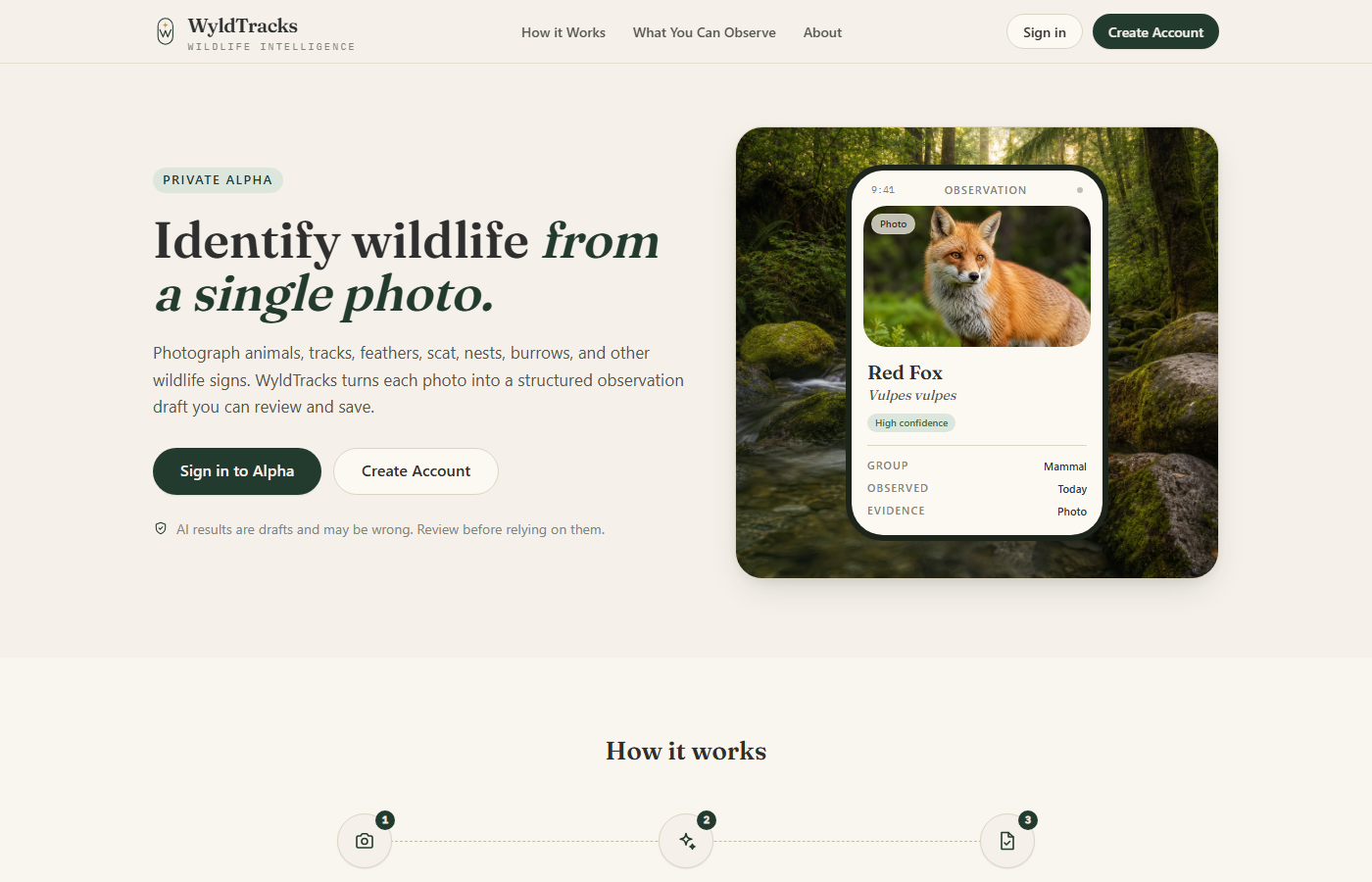
Landing + Product Positioning
Public positioning at wyldtracks.com: wildlife intelligence for naturalists, with a dossier preview showing what a saved observation looks like.
PRODUCT STORY 05 / WILDLIFE INTELLIGENCE
An AI-powered animal field journal that helps people identify wildlife and animal signs, review the evidence, and build a private record they can trust.
Most identification apps give you a guess and move on. Naturalists need evidence, uncertainty, location context, and a record they can revisit without handing their field notes to a black-box label.
Founder and builder: product direction, UX, Supabase schema, Edge Function AI pipeline, GBIF validation layer, and private alpha launch at wyldtracks.com.
A working private-alpha loop: upload a photo, get a structured AI draft checked against GBIF, review and edit, save to a personal journal with private image storage.
From /observations/new, upload a photo and add optional context: field notes, tags, and GPS via map picker or device location. The observation stays a draft until you choose to run analysis.
The analyze-observation Edge Function downloads the private image, calls OpenAI vision, and returns structured JSON: primary and alternative candidates, field marks, summaries, confidence, and sign-specific analysis when the subject is not a visible animal.
GBIF taxonomy match confirms whether the proposed scientific name exists. An occurrence check near the coordinates adds plausibility signal (supporting evidence, not proof). Confidence adjusts deterministically when validation is weak.
The review screen shows candidates, validation panels, and editable species fields. Nothing saves automatically. The user decides what goes into their journal.
Saved observations land in /journal with search, filters, and view modes. Detail pages use the Wildlife Dossier layout: evidence, taxonomy, validation metadata, and private signed image URLs.
Capture the evidence. Understand the animal. Review the record. Share carefully later.
Structured candidates, field marks, visible evidence, uncertainty notes, and similar species. The AI explains what it sees, not just a single label.
Server-side checks against GBIF taxonomy and nearby occurrence records. Confidence adjusts when names or location plausibility are weak.
Premium observation detail UI: plain and scientific summaries, taxonomy, validation warnings, tags, and natural history context when available.
List, grid, and field-notes view modes with search and filters. Every observation is private to the signed-in user via row-level security.
Animals, tracks, scat, feathers, fur, bones, nests, burrows, and unknown signs. Animal-only MVP scope avoids plant ID sprawl.
In-app feedback, feature request voting, admin triage, and AI cost tracking. Built to learn during private alpha, not just ship features.
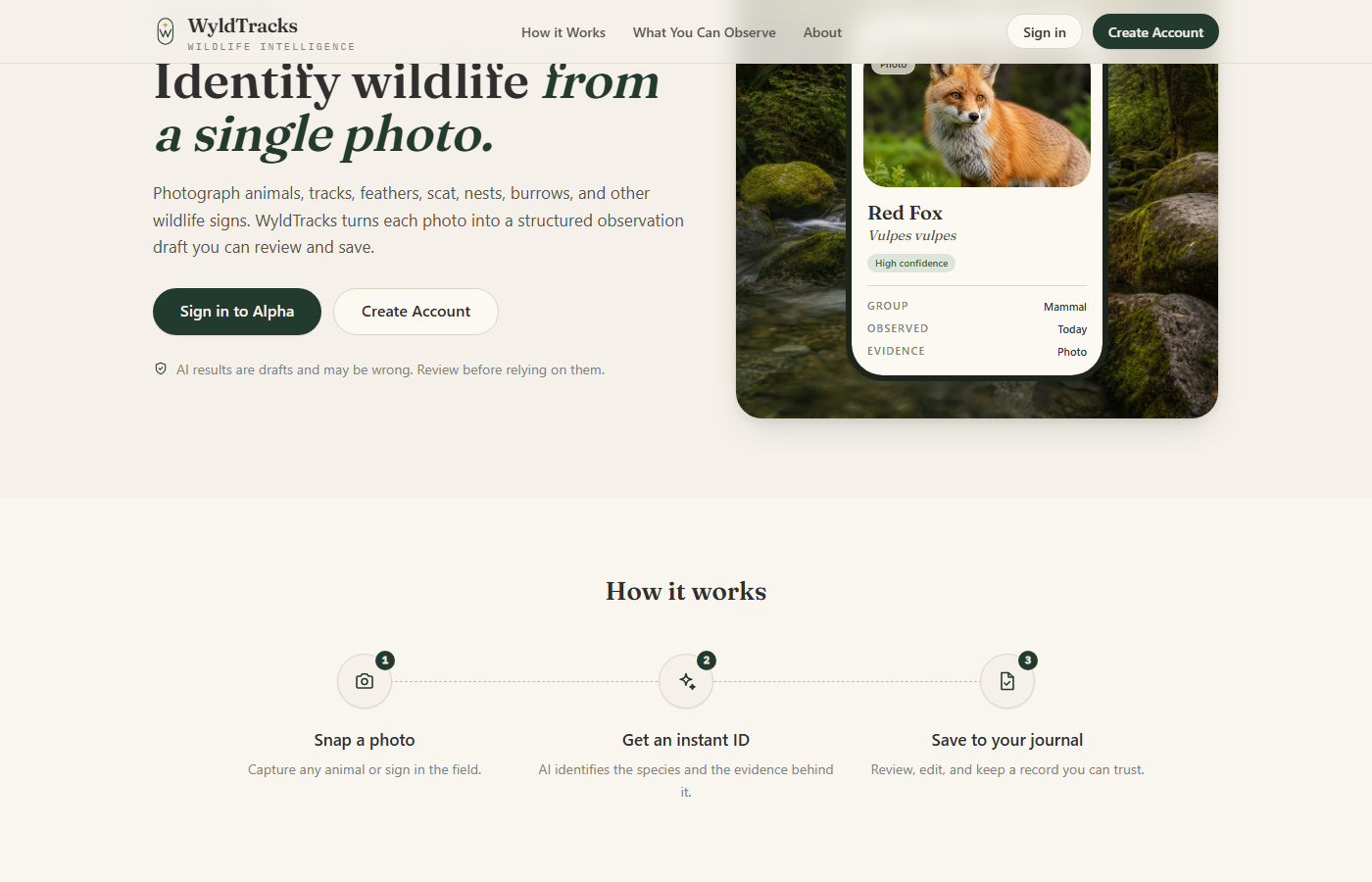
Sanitized diagrams and wireframes, not the original proprietary product.
Public positioning at wyldtracks.com: wildlife intelligence for naturalists, with a dossier preview showing what a saved observation looks like.
Three-step loop on the landing page: snap a photo, get an evidence-backed ID, review and save to your journal.
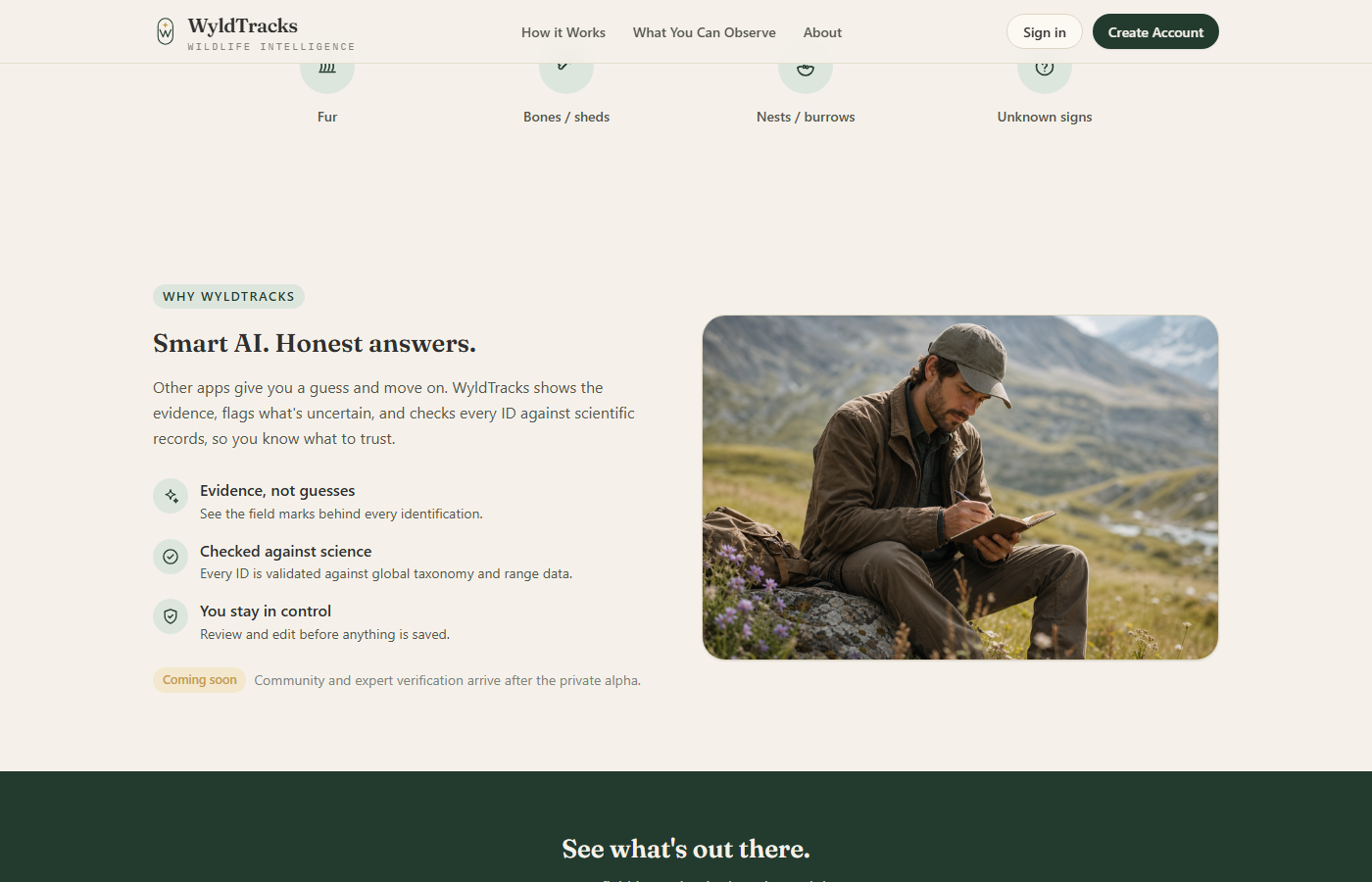
Landing section explaining GBIF cross-checks and why WyldTracks does not blindly trust the AI output.
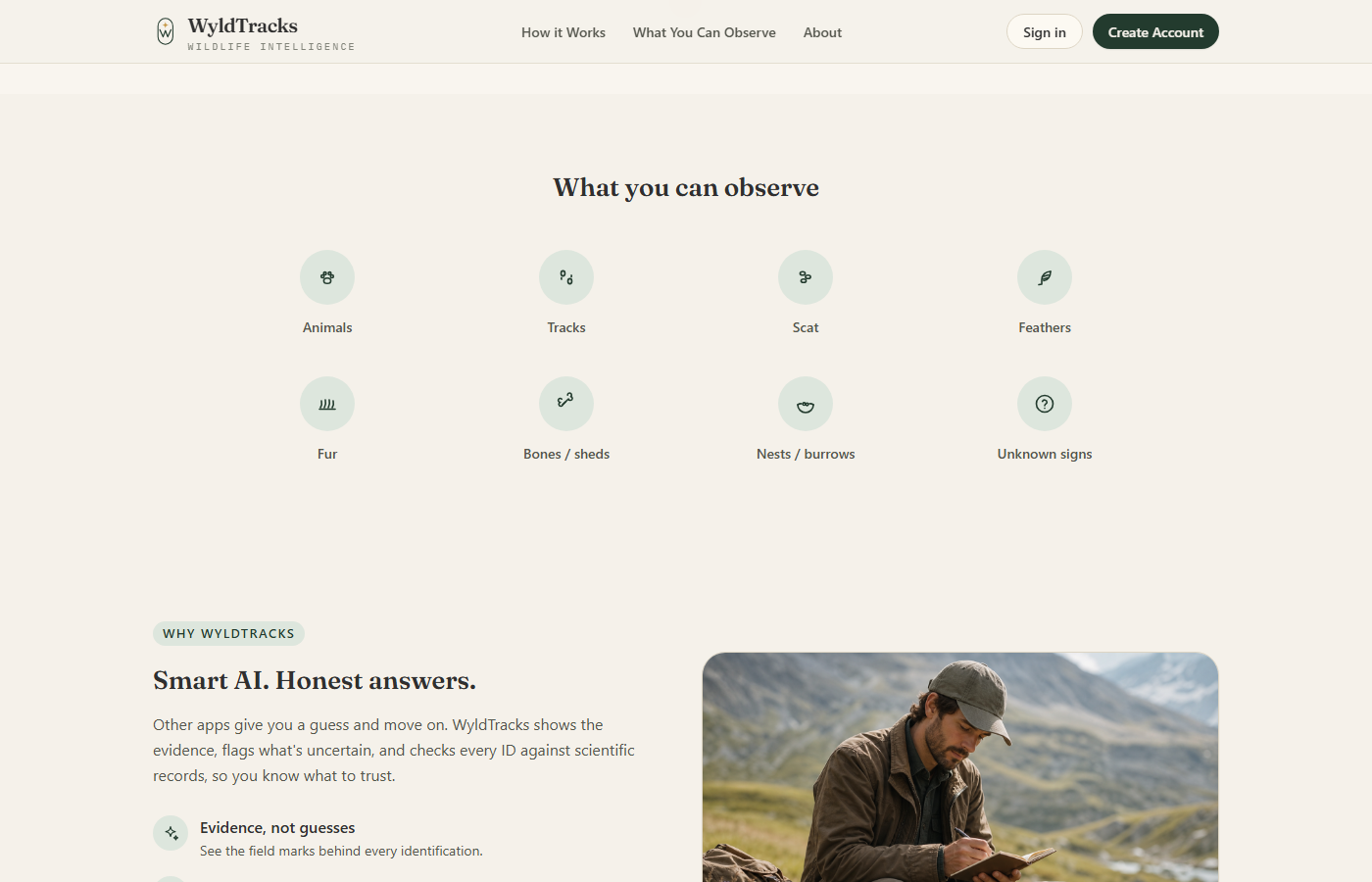
Animal-only scope for alpha: visible animals plus field signs, without expanding into plants or a public social feed.
The first-pass data model centers on a few core objects:
Enough structure to ship the alpha, not a schema built for features that do not exist yet.
auth.users → observations (RLS: owner read/write)observations → observation-images storage path ({userId}/{uuid}.ext)observations.ai_result_original (immutable AI output) vs reviewed_result (user-edited save)Edge Function → OpenAI vision + GBIF taxonomy + occurrence APIsfeedback_items → admin triage at /admin/feedbackfeature_requests ← feature_request_votes (alpha voting board)For an alpha version, I would focus on:
Community review queues, public sharing, wildlife maps, reviewer roles UI, offline sync, and plant identification wait until the private journal loop is proven with alpha testers.
The design lesson: trust in nature apps comes from showing your work.
Candidates, field marks, validation warnings, and an explicit human review step matter more than a confident single label. GBIF adds scientific grounding without pretending the photo is verified.
If the north star is a wildlife intelligence network, the alpha had to prove one thing first: people will save observations they believe in. Everything public comes after that loop feels good on a real hike.